When a country is actively fighting for survival against armed groups, reducing its people to gang tropes in pop culture feels deeply out of touch and harmful. For Haitian communities—both on the island and across the diaspora in places like South Florida—gang violence isn’t an aesthetic; it is an active humanitarian crisis tearing families and neighborhoods apart.
For decades, the Grand Theft Auto franchise has built its empire by holding a distorted, satirical mirror up to American culture. With Grand Theft Auto 6 returning players to the neon-soaked streets of Vice City—Rockstar Games’ fictionalized take on Miami—anticipation around the game’s portrayal of South Florida’s diverse communities has reached a fever pitch. Among those communities is Miami’s vibrant Haitian diaspora, whose presence in the game brings up a complicated and deeply personal question: why does pop culture still insist on viewing Haitians through the lens of gangs and crime?
From trailers, screenshots, and pre-release lore breakdowns, it is clear that GTA 6 features a Haitian street gang known as San4San (S4S). Based in La Pearl—an in-game neighborhood modeled after Miami’s real-life Little Haiti—the group draws heavy inspiration from Zoe Pound, a real-world Miami gang formed by Haitian immigrants. In Haitian Creole, “san” carries a double meaning of both “blood” and “100,” giving the gang’s name a dual identity of “blood for blood” or “100%.” Visually, members sport gold S4S chains, blue bandanas, and chest tattoos reading “Perle,” while operating a record label called Sound4Sound as a legitimate business front.
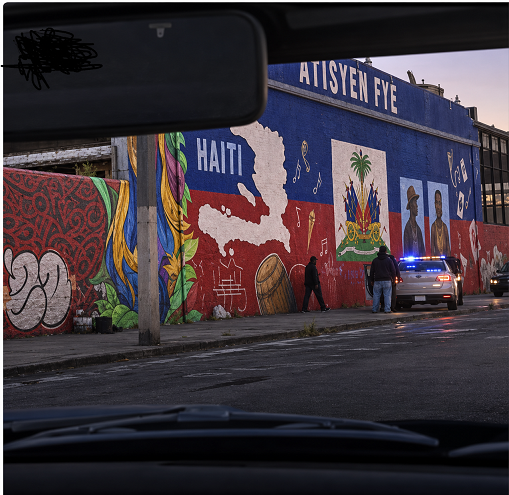
In 2002, the original GTA: Vice City sparked widespread protests and legal action from South Florida Haitian advocacy groups over a notorious mission objective that explicitly instructed players to “Kill the Haitians,” eventually forcing Rockstar to patch the script. In GTA 6, developers have woven more authentic cultural touches into the background—highlighting iconic street murals in La Pearl and featuring classic konpa music from legendary Haitian bands like Zenglen.
Yet, even with a more grounded aesthetic, the core trope remains intact: once again, Haitians in a major global media property are defined largely by organized crime.
Defenders of the franchise often point out that Grand Theft Auto is an equal-opportunity crime simulator. In Rockstar’s universe, virtually every ethnic and social group—whether Italian mobsters, Irish syndicates, Russian cartels, Colombian traffickers, or white biker clubs—is organized around criminal enterprise. When building a fictionalized Miami, developers pull directly from South Florida’s gritty 1980s and modern history.
However, that argument overlooks a critical imbalance in media representation. While Italian Americans or Irish Americans have decades of mainstream movies, television shows, and literature celebrating their histories, triumphs, and everyday humanity to offset mafia tropes, Haitian Americans have rarely been afforded that same breadth of positive visibility. In U.S. news and entertainment throughout the 1980s and 1990s, Haitian immigration and South Florida neighborhoods were overwhelmingly framed through sensationalized stories of poverty, political turmoil, and street crime. When positive stories are scarce, every criminal caricature carries far heavier weight.
More importantly, entertainment does not exist in a vacuum—and right now, the real-world context makes these tropes feel especially tone-deaf.
Today, Haiti is enduring an unprecedented humanitarian and security crisis. Armed gang coalitions have violently overrun large parts of the country, displacing more than 1.4 million people and pushing millions more into severe food insecurity. Everyday Haitian citizens, local police, and international forces are actively fighting for survival, working desperately to reclaim neighborhoods and vital corridors from the grip of armed groups.
In this reality, Haitians are not the architects of gang violence—they are its primary victims and its fiercest opponents.
For major entertainment studios, street gangs are treated as fictional set pieces, edgy aesthetics, or vehicles for satire. But for Haitian communities—both on the island and across the diaspora in places like South Florida—gang violence is not a game mechanic. It is an active, ongoing trauma tearing families apart and threatening the stability of an entire nation.
When global pop culture continues to reduce a resilient people to one-dimensional gang stereotypes at the exact moment they are fighting to save their homeland from real-world armed groups, it stops feeling like harmless satire. Instead, it reinforces damaging stigma, flattens a rich culture, and ignores the extraordinary courage of Haitians working every day to rebuild and protect their communities. Until mainstream media starts telling the fuller story of Haitian resilience, creativity, and strength, recycling old gang tropes will always feel like a step backward.
If only Bukele could step into those games and fight the gangs.


