By Wilner Jean Louis
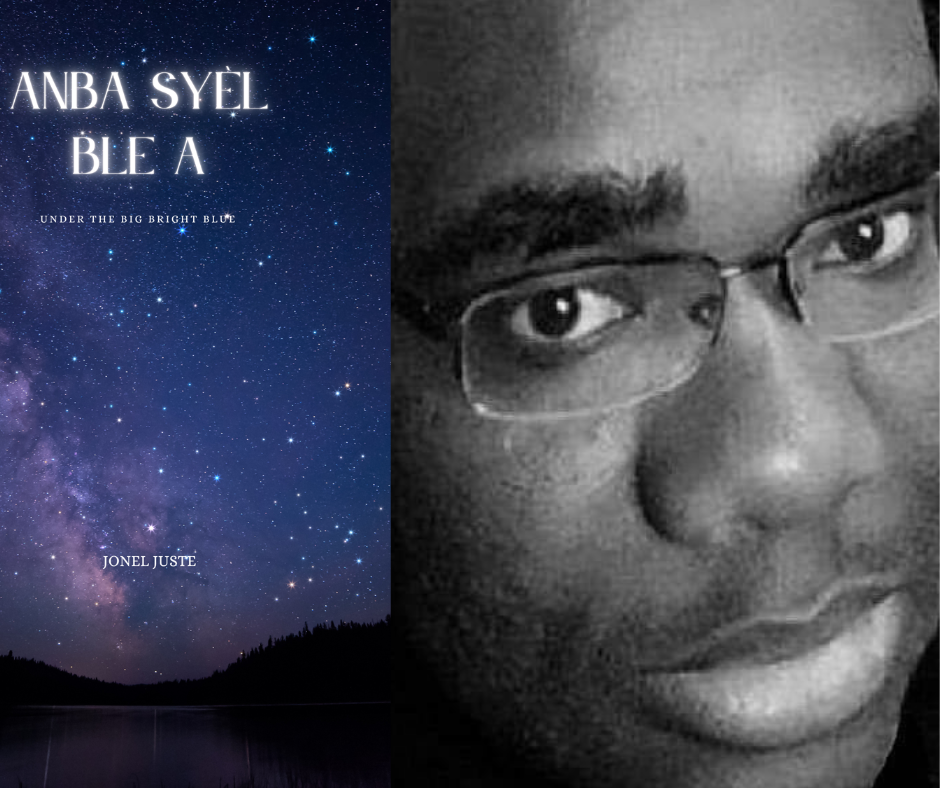
Jonel Juste publishes in 2025 Anba Syèl Ble a (Under the Big Bright Blue) with Éditions Marginales. It is a collection of short stories in Haitian Creole and English, where the simple, musical language becomes a space for reflection on memory, exile, and spirituality. It is a book that blurs the lines between testimony and fiction, between intimate narrative and collective speculation.
The author makes this clear from the introduction, presenting his book as: « yon bann koze k ap dewoule toulejou anba syèl ble a, kote pechè latè de bra balanse ap fè e defè » (“fragments of stories unfolding every day under the blue sky, where humans do whatever”). Everything is said here: the ambition is to capture fragments of existence, under a sky which, despite violence and fractures, remains blue.
The first story, Tout Syèl la Klere (“All Is Illuminated”), projects us into the year 2050. Alexander, a Haitian doctor trained in the United States, boards a plane to Ouanaminthe in northern Haiti. But the surprise is that he is one of the few Haitians on the plane, since most of the passengers are white: « pifò ladan yo pa Ayisyen, se blan » (“most of them were not Haitian, but white”). The reversal is striking: it is no longer Haitians fleeing their country in search of work, but Westerners going to Haiti, now a land of opportunity—an image that recalls the days following the January 12 earthquake.
In just a few pages, Juste offers a powerful parable about migratory flows, the illusion of progress, and the irony of history. The story invokes the memory of the 2010 disaster, the NGOs, the poorly managed international aid, in order to highlight the reversal of human flows. In one passage, Alexander recalls: « An 2010, pandan li t ap vin chèche lavi Etazini, gen yon bann blan ki yo menm t apral chèche lavi Ayiti, peyi Aleksann t ap kouri kite a » (““In 2010, while he was going to seek a better life in the United States, a bunch of white people were, themselves, heading to seek a better life in Haiti—the very country Alexander was fleeing”). History repeats itself, but in reverse.
This realism tinged with science-fiction gives the text a political resonance. One thinks of Jonathan M. Katz’s analysis in The Big Truck That Went By (2013), referenced in the story, but also of the tradition of Haitian literature that makes national memory converse with imagined futures. Alexander is not only a character: he is a consciousness in motion, shaped by history, technology, and exile. When he rediscovers, in Ouanaminthe, the simplicity of life without robots, « li te redekouvri senplisite lavi. Tout syèl la te klere. Li te pran tan pou l respire, pou l tande chan zwazo, bri van k ap layite nan fèy bwa, bri kè l k ap bat » (“he rediscovered the simplicity of life. The whole sky was shining. He took the time to breathe, to hear the birds singing, the sound of the wind spreading through the leaves of the trees, the beating of his own heart”). Literature here becomes a place of resistance, a way of restoring value to the sensitive, the natural, to that which escapes technological progress.
But the book is not reduced to this inverted dystopia. Other stories shift the lens, exploring intimacy and family memory. In Kisa ki nan tou a ? (“What’s in the Hollow?”), the narrator recalls the fear of a hollow tree in his grandmother’s yard. Curiosity triumphs over prohibition, and the mystery is resolved with the appearance of a simple toad. The scene, both funny and terrifying, reveals much about Juste’s writing: a way of transfiguring childhood, turning superstitions and popular fears into the material of an initiation tale.
The same tension is found in Nou chape anba yo ! (“A Lucky Escape!”), the story of a taptap accident in Port-au-Prince. The narrator is the sole survivor and wonders if he is still alive or if he has entered a transitional space between life and death. Here, the writing becomes breathless, almost poetic, saturated with apocalyptic visions: « Bra ak janm vole nan kat pwen kadino. Tèt moun ap woule atè tankou zetwal ki pèdi fren, k ap pwonmennen san konn kote yo prale » (“Arms and legs flew in every direction like cards tossed to the wind. Heads rolled across the asphalt like wandering stars, unsure of their orbit”). This raw realism is overtaken by a meditation on the fragility of life and the persistence of memory.
Through these stories, Jonel Juste extends a double lineage. That of Haitian literature of memory, from Jacques Roumain to Edwidge Danticat, which knows how to transform collective pain into narrative art. And that of contemporary literature of the real, as analyzed by Dominique Viart, where testimony, traces, and fragments become legitimate forms of creation. But he adds his own tone: a spirituality that is not imposed, that does not preach, but that nourishes the texts. It surfaces in the choice of images, in the search for light, in this conviction that words can still save.
Anba Syèl Ble a is a book of shadow and light. Its strength lies in its ability to hold memory and anticipation together, realism and dream, drama and hope. At a time when Francophone literatures are more than ever interrogating colonial fractures, forced displacements, and globalization, Jonel Juste’s writing reminds us that we can no longer write only within the shadows of our own walls. Under the blue sky he gives us to see, Haiti becomes not only a space of memory, but a laboratory of the future.
To read the book, click HERE.


